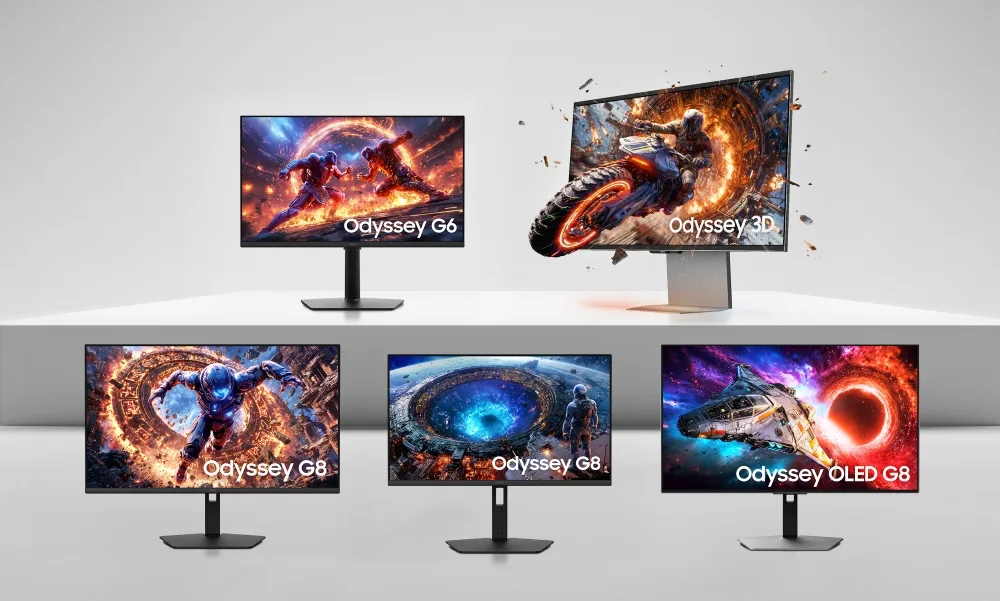
Samsung’s dropping some serious hardware ahead of CES 2026, and the centerpiece of its 2026 Odyssey lineup might just be the most ambitious gaming monitor we’ve seen in years. The 32-inch Odyssey 3D (G90XH) combines a 6K resolution with glasses-free stereoscopic 3D technology, real-time eye tracking, and a dual-mode refresh rate system that scales from precision visuals to competitive speeds.
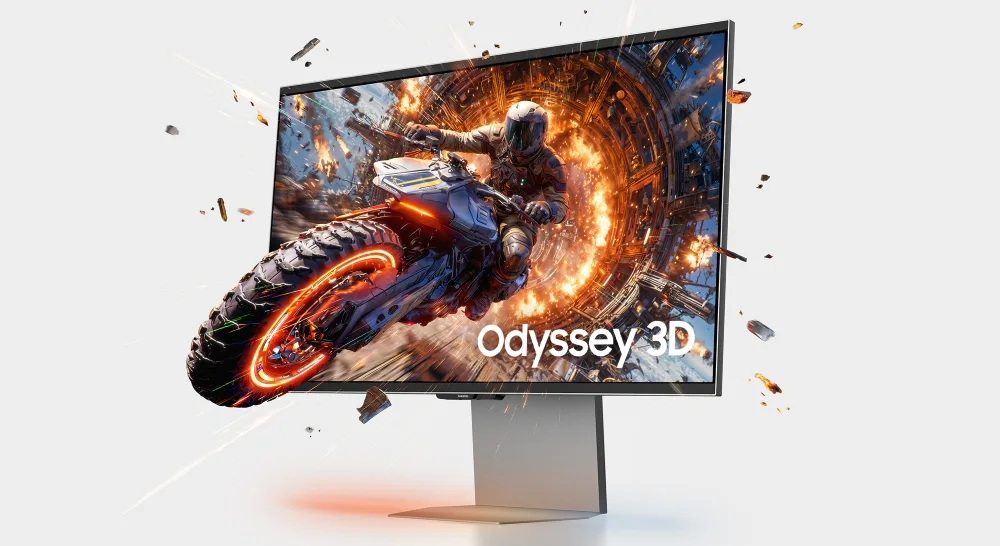
While Samsung bills this as the “world’s first 6K display with glasses-free 3D,” that’s only part of what makes this monitor interesting. Beyond the headline-grabbing 3D capabilities, you’re looking at a display that pushes 6,144 x 3,456 pixels at 165Hz natively or drops to 3K resolution for a 330Hz dual-mode experience. Samsung also unveiled four other monitors in the same lineup, including what they’re claiming is the world’s first 1,040Hz gaming monitor through dual-mode operation.
Odyssey 3D Specs
| Specification | Details |
|---|---|
| Screen Size | 32 inches |
| Panel Type | IPS |
| Native Resolution | 6K (6144 x 3456) |
| Native Refresh Rate | 165Hz |
| Dual Mode | 330Hz at 3K resolution |
| Response Time | 1ms GtG |
| 3D Technology | Glasses-free with eye tracking |
| Connectivity | HDMI 2.1, DisplayPort 2.1 |
| Optimized Games | The First Berserker: Khazan, Lies of P: Overture, Stellar Blade |
| Price | TBA (expected at CES 2026) |
The 32-inch Odyssey 3D doesn’t have much in the way of direct competition. At 6K resolution, it’s matching Apple’s Pro Display XDR in pixel count (6,144 x 3,456 versus Apple’s 6,016 x 3,384), but Samsung’s targeting gamers instead of creative professionals. Where Apple’s display maxes out at 60Hz and emphasizes color accuracy and HDR performance, Samsung prioritizes refresh rate and motion clarity.
The panel uses IPS technology with a 1ms gray-to-gray response time, which is respectable for an LCD but not groundbreaking. However, the glasses-free 3D implementation is where things get technically interesting. Samsung employs lenticular lens technology combined with real-time eye tracking cameras that monitor your viewing position and adjust the image accordingly. This creates depth perception without requiring special eyewear.
How Glasses-Free 3D Works
If you remember the Nintendo 3DS or Samsung’s failed 3D TV experiments from the 2010s, you might approach this with some skepticism, but the technology has evolved substantially since then. Modern lenticular displays like Samsung’s use a layer of precisely engineered lenses overtop the LCD panel that redirect light to create different images for your left and right eyes. When combined with eye tracking cameras that monitor your head position in real time, the monitor can adjust which pixels you see from each eye, creating the illusion of depth.
According to Samsung’s engineering documentation, each monitor receives individual post-assembly calibration for both the camera and display panel, with unit-specific data stored in a dedicated chip. This addresses manufacturing tolerances that previously made glasses-free 3D “not feasible” for consumer applications.
The practical limitation is that this only works for a single viewer. Eye tracking can’t accommodate multiple people simultaneously, so if you’re planning couch co-op sessions, one person’s getting a 3D experience while everyone else sees a degraded 2D image.
The Rest of Samsung’s 2026 Odyssey Lineup
Samsung didn’t just announce one monitor. They’re rolling out five new Odyssey models that target different segments of the gaming market:
Odyssey G6 (G60H) – a 27-inch display that pushes refresh rates to what Samsung claims is a world-first 1,040Hz through dual mode. Native QHD resolution supports up to 600Hz, but drop to HD (720p) and you’ll hit that four-digit refresh rate.
Whether anyone can actually benefit from 1,040Hz is an open question. Most competitive gamers struggle to notice differences above 360Hz, and you’d need frame rates well into the 900+ FPS range to take advantage of it.
Odyssey G8 Series: Three Flavors of High-Resolution Gaming
Samsung’s expanding the G8 line with three distinct models that balance resolution and speed differently:
The 32-inch G80HS – matches the Odyssey 3D’s 6K resolution but ditches the 3D technology for a more straightforward gaming experience. It delivers 165Hz natively with dual mode support for 330Hz at 3K resolution.
The 27-inch G80HF – offers 5K resolution (5120 x 2880) at 180Hz native, boosting to 360Hz in QHD through dual mode. This creates an interesting middle ground for users who want higher pixel density than 4K but don’t need the full 6K resolution.
The 32-inch OLED G8 (G80SH) – uses a QD-OLED panel with 4K resolution and a 240Hz refresh rate.