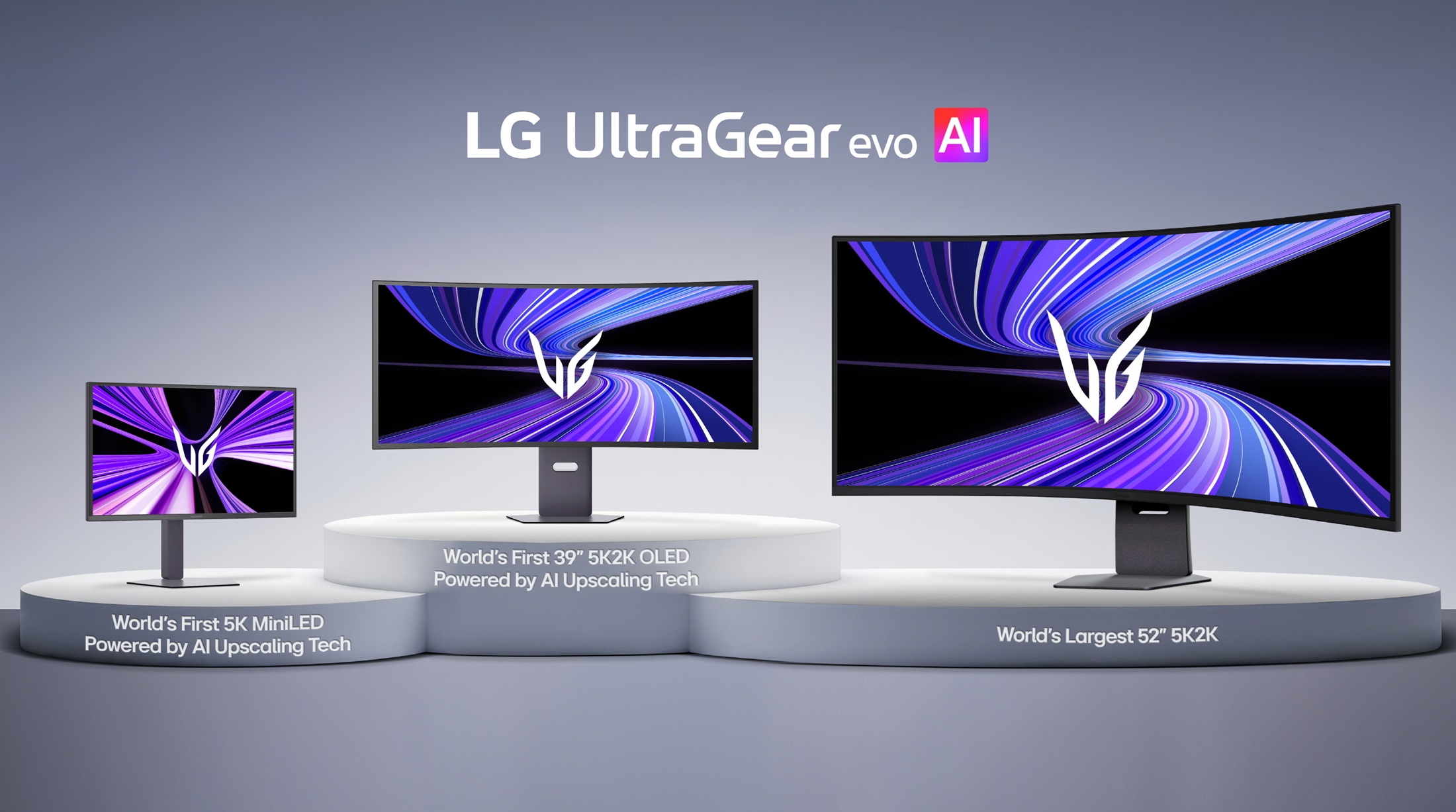
Ahead of CES 2026, LG has announced a new premium gaming monitor lineup with designation UltraGear evo. What sets this lineup apart isn’t just higher resolutions or faster refresh rates. Instead, LG is tackling PC gaming’s most persistent problem (especially in light of the AI-induced price hikes on RAM and other hardware): the GPU horsepower required to drive 5K displays.
Ironically, the problem caused by AI might partly be solved by AI, or at least that’s the idea. LG claims its proprietary on-device AI upscaling can deliver “5K-class clarity” without taxing your graphics card, potentially letting gamers skip expensive GPU upgrades.
The initial UltraGear evo lineup includes three flagship models spanning different technologies and sizes. There’s the 39-inch curved OLED ultrawide, a 27-inch Mini LED display, and a massive 52-inch curved gaming monitor. LG will showcase these displays at CES 2026 through two experience zones: a “Dream Setup” inspired by Reddit gaming communities and a SimCraft-powered racing simulation featuring the 39-inch model.
LG UltraGear evo 39GX950B: Tandem OLED Meets 5K2K
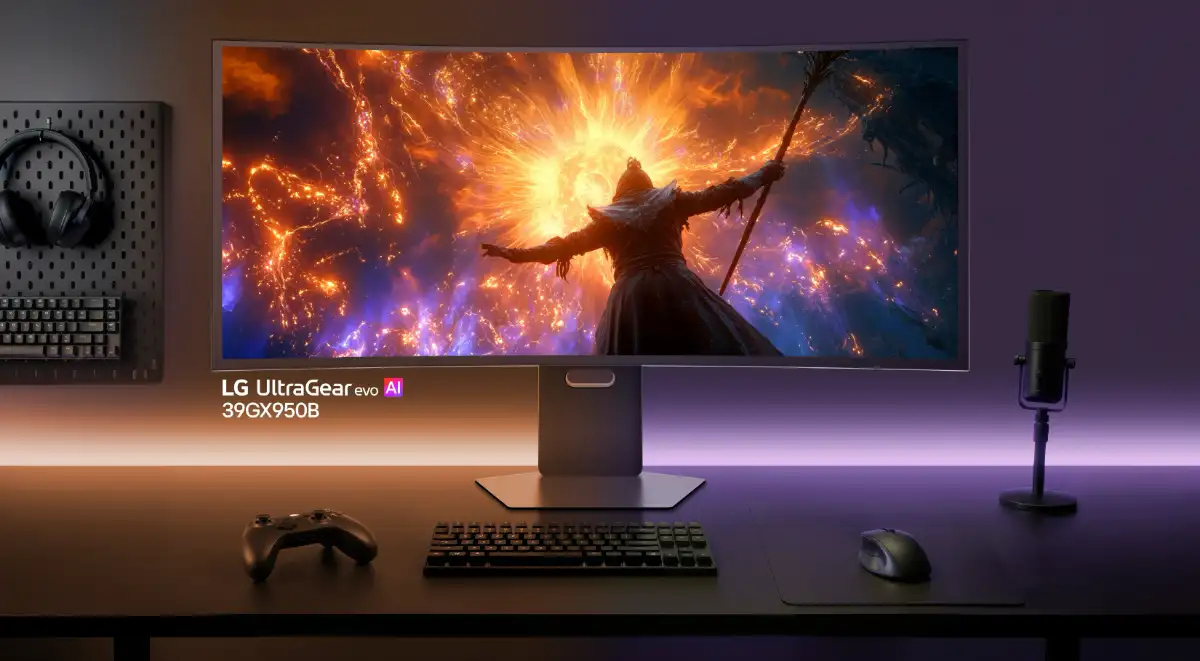
The 39GX950B is the world’s first 39-inch 5K2K OLED gaming monitor. While LG’s 45-inch 5K2K model (45GX950A) launched earlier in 2025, this new 39-inch variant offers a more compact footprint with different curvature and features. LG addressed feedback about its previous ultrawide OLED monitors by implementing a less aggressive 1500R curve instead of the 800R found on earlier models.
At 5120×2160 resolution, you’re getting 142 pixels per inch, which falls between the clarity of 27-inch 1440p and 32-inch 4K displays.
The panel uses LG’s Primary RGB Tandem OLED technology, which stacks multiple light-emitting layers to improve brightness, color accuracy, and longevity compared to traditional WOLED panels. Peak brightness reaches up to 1,500 nits in HDR, with the monitor certified for VESA DisplayHDR True Black 500. Color coverage hits 99.5% of the DCI-P3 gamut.
For gamers who prioritize frame rates over resolution, the 39GX950B includes Dual Mode functionality. Press a hotkey and the display switches from 165Hz at 5K2K to 330Hz at WFHD (2560×1080), which is a whole lot easier to power with a mainstream consumer graphics card.
Specs
| Feature | Specification |
|---|---|
| Screen Size | 39 inches |
| Resolution | 5120 x 2160 (5K2K) |
| Aspect Ratio | 21:9 |
| Pixel Density | 142 PPI |
| Panel Technology | Primary RGB Tandem OLED |
| Curvature | 1500R |
| Refresh Rate (Native) | 165Hz |
| Refresh Rate (Dual Mode) | 330Hz at 2560×1080 |
| Response Time | 0.03ms (GtG) |
| Peak Brightness | 1,500 nits (HDR) |
| HDR Certification | DisplayHDR True Black 500 |
| Color Gamut | 99.5% DCI-P3 |
| Connectivity | DisplayPort 2.1 (UHBR20), 2× HDMI 2.1, USB-C (90W PD) |
| AI Features | 5K AI Upscaling, AI Scene Optimization, AI Sound |
LG UltraGear evo 27GM950B: Solving Mini LED’s Blooming Problem
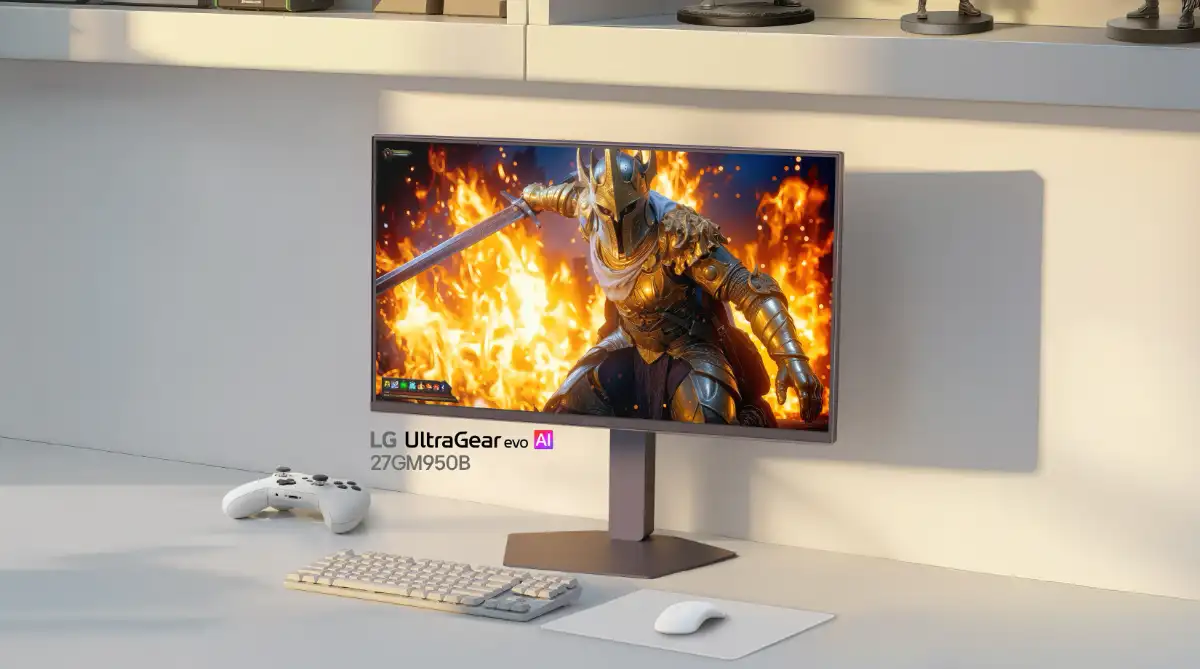
LG positions the 27GM950B as the world’s first (yes, another one) 5K Mini LED gaming monitor, but the interesting part is how the company tackled blooming. Anyone who’s used Mini LED displays knows about the halo effect around bright objects on dark backgrounds. LG’s “Zero Optical Distance” engineering minimizes the gap between the 2,304 local dimming zones and the panel itself, which the company claims dramatically reduces this visual artifact.
Like its OLED sibling, the 27GM950B packs 5120×2880 pixels into a 27-inch panel, which works out to 218 PPI. The Mini LED backlight delivers up to 1,250 nits peak brightness with VESA DisplayHDR 1000 certification. As you’d expect, this is noticeably brighter than typical OLED displays, which makes it more suitable for HDR gaming in well-lit rooms. The trade-off is response time at 1ms gray-to-gray instead of the near-instantaneous 0.03ms you get from OLED panels.
Dual Mode functionality works similarly to the 39-inch model. You can switch to 330Hz at QHD (2560×1440) – a lower but still reasonably sharp resolution on a 27-inch display.
LG UltraGear evo 27GM950B Specifications
| Feature | Specification |
|---|---|
| Screen Size | 27 inches |
| Resolution | 5120 x 2880 (5K) |
| Aspect Ratio | 16:9 |
| Pixel Density | 218 PPI |
| Panel Technology | IPS with Mini LED backlight |
| Local Dimming Zones | 2,304 |
| Refresh Rate (Native) | 165Hz |
| Refresh Rate (Dual Mode) | 330Hz at 2560×1440 |
| Response Time | 1ms (GtG) |
| Peak Brightness | 1,250 nits |
| HDR Certification | DisplayHDR 1000 |
| Color Gamut | Not specified |
| Connectivity | Not specified |
| AI Features | 5K AI Upscaling, AI Scene Optimization, AI Sound |
LG UltraGear evo 52G930B: Gaming’s Largest 5K2K Display
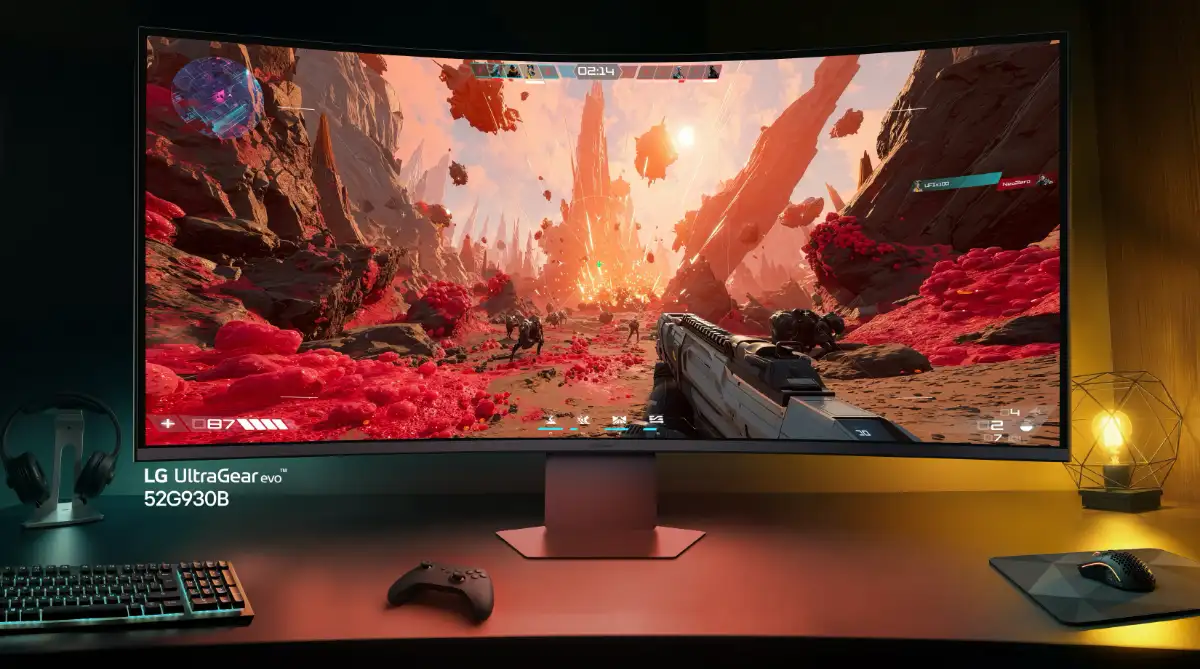
If the 39-inch model seems too small, LG has you covered. Its huge 52G930B display earns the title of world’s largest 5K2K gaming monitor, stretching 52 diagonal inches, but with the same 5120×2160 resolution as the 39-inch OLED.
The massive screen features what LG describes as a “12:9” aspect ratio, though this appears to be an error in the press materials. The actual aspect ratio is 21:9, identical to other 5K2K ultrawides. What you’re getting is the vertical viewing height of a standard 42-inch 16:9 display with a 33% wider horizontal span compared to UHD monitors.
Despite its size, the 52G930B maintains a 240Hz refresh rate at native resolution. The 1000R curvature is less aggressive than the 39-inch model’s 1500R curve, which makes sense given the increased screen real estate. Notably, the 52G930B doesn’t include the on-device AI upscaling features found on the smaller models.
LG UltraGear evo 52G930B Specifications
| Feature | Specification |
|---|---|
| Screen Size | 52 inches |
| Resolution | 5120 x 2160 (5K2K) |
| Aspect Ratio | 21:9 |
| Panel Technology | LCD (likely edge-lit) |
| Curvature | 1000R |
| Refresh Rate | 240Hz |
| Response Time | Not specified |
| HDR Certification | DisplayHDR 600 |
| Color Gamut | Not specified |
| Connectivity | Not specified |
| AI Features | None |
The AI Upscaling Advantage(?)
LG’s on-device AI solution is the headline feature distinguishing these monitors from conventional high-resolution displays. According to LG’s announcement, the monitor analyzes and enhances content in real time before it reaches the panel. By handling spatial reconstruction internally rather than on your PC, LG suggests gamers might maintain higher frame rates at lower native resolutions while still enjoying sharp 5K visuals.
It remains to be seen how well this works, especially in combination with existing upscaling solutions handled by the GPU, such as Nvidia’s DLSS and AMD’s FSR.